Social calendar
The social calendar shows planned, booked, live and refused posts by day on your social accounts, lets editors move sends, and narrows to one network.
Watch the video
The social calendar is the plan for every network in one place. Day by day, it shows what still has to be written and what the app has booked to send, along with what’s already live or was refused. It reads the social accounts you connected yourself, whatever brand each post was written for, and anyone who follows the social plan can read it. Editors also use it to plan posts and move them around.
Open the calendar
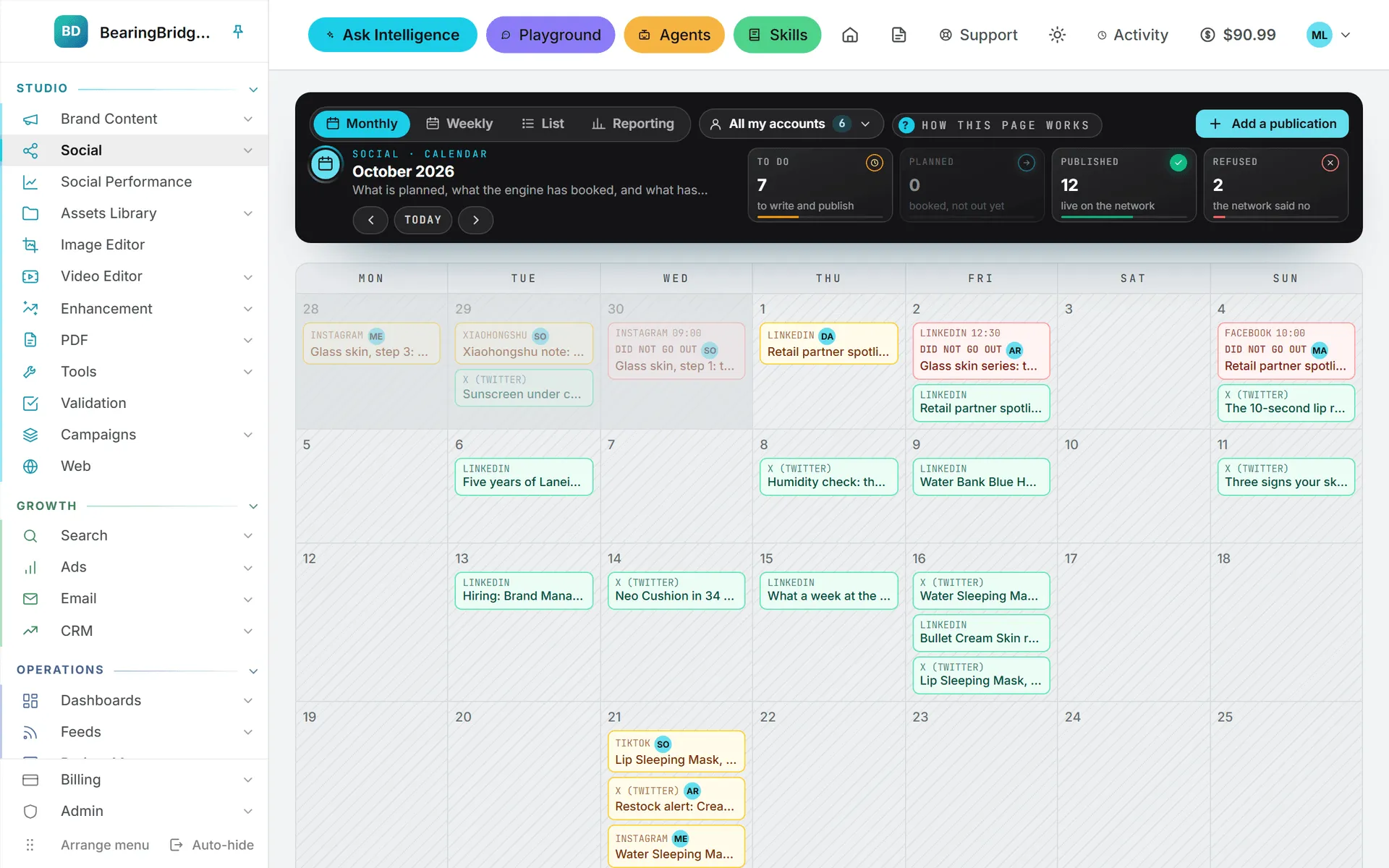
Click Social in the left menu, then Calendar. It opens on the current month, and the dark band at the top holds the controls:
- Monthly, Weekly, List and Reporting, to switch pages
- the account button, to pick the network and which of your social accounts the calendar reads
- How this page works, a short help note
- Add a publication
- the month or week on view, with arrows to step back and forward and a Today button to jump back
- four tiles that count the period by state
What the colors mean
Each publication is a colored chip or card, and the color tells you whether it’s out yet.
| Color | Tile | Meaning |
|---|---|---|
| Amber | To do | Planned, but nothing is booked. Someone still has to write it and publish it. |
| Blue | Planned | Booked with the app, which will send it by itself at the hour shown. It’s not out yet. |
| Green | Published | Live on the network. |
| Red | Refused | Its moment came and the network said no. The reason is on the card, and the post’s publishing step has Try again now. |
The four tiles count the month or week on screen (on the list view, the period and the search), and the bar under each number is that state’s share of the period. It’s a quick read on how much of the period has actually gone out.

The monthly view
The month is a grid of weeks, starting on Monday. Today is lit with a cyan frame and a Today tag, and days outside the month are faded. Days gone by sit on a grey hatched ground: what is done is done, so a past day takes no new publication, though its chips still open (to add the link, for instance). Each chip shows the network, the hour it goes out if it’s booked, a short state (Planned, Sending or Did not go out), the initials of the person in charge and the title. Hover a chip to read the account it goes out on and any error.
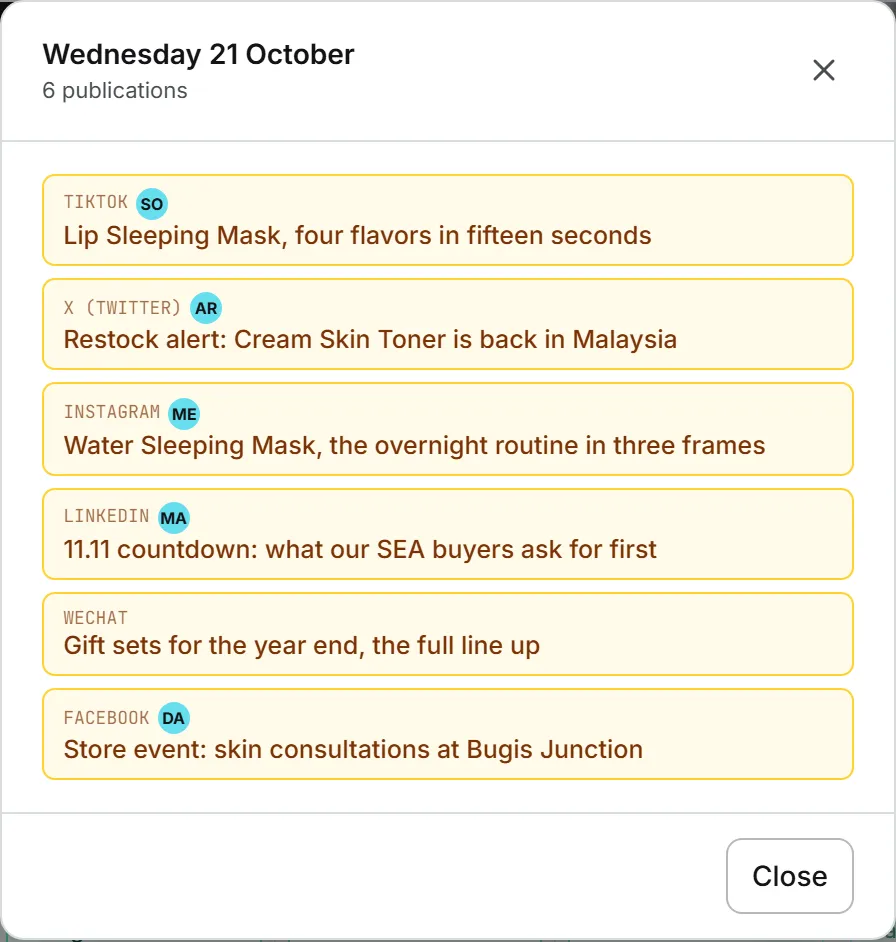
A day shows up to four chips. When it holds more, a +2 more button (with the real count) sits under the fourth, so one busy day never stretches its whole week down the page. Click it to open the whole day in a window: every publication of that day, in the order they go out, the ones with no hour (planned by hand) last. Click one to open it, or click Add a publication at the foot to plan one more on that day (not on a past day). Close, the X or Escape takes you back to the month.
Hover a day from today on and + add appears. Click anywhere in that day to plan a publication on it. The day cells and the chips also answer Enter and the space bar.
The weekly view
The week shows one row per day, with each publication as a full card. A card shows its state, the network, who’s in charge, the title and any notes. When the app is set to send it, the card lists every account it goes out on, with the hour, the state, a link to the live post and the network’s error if there was one.
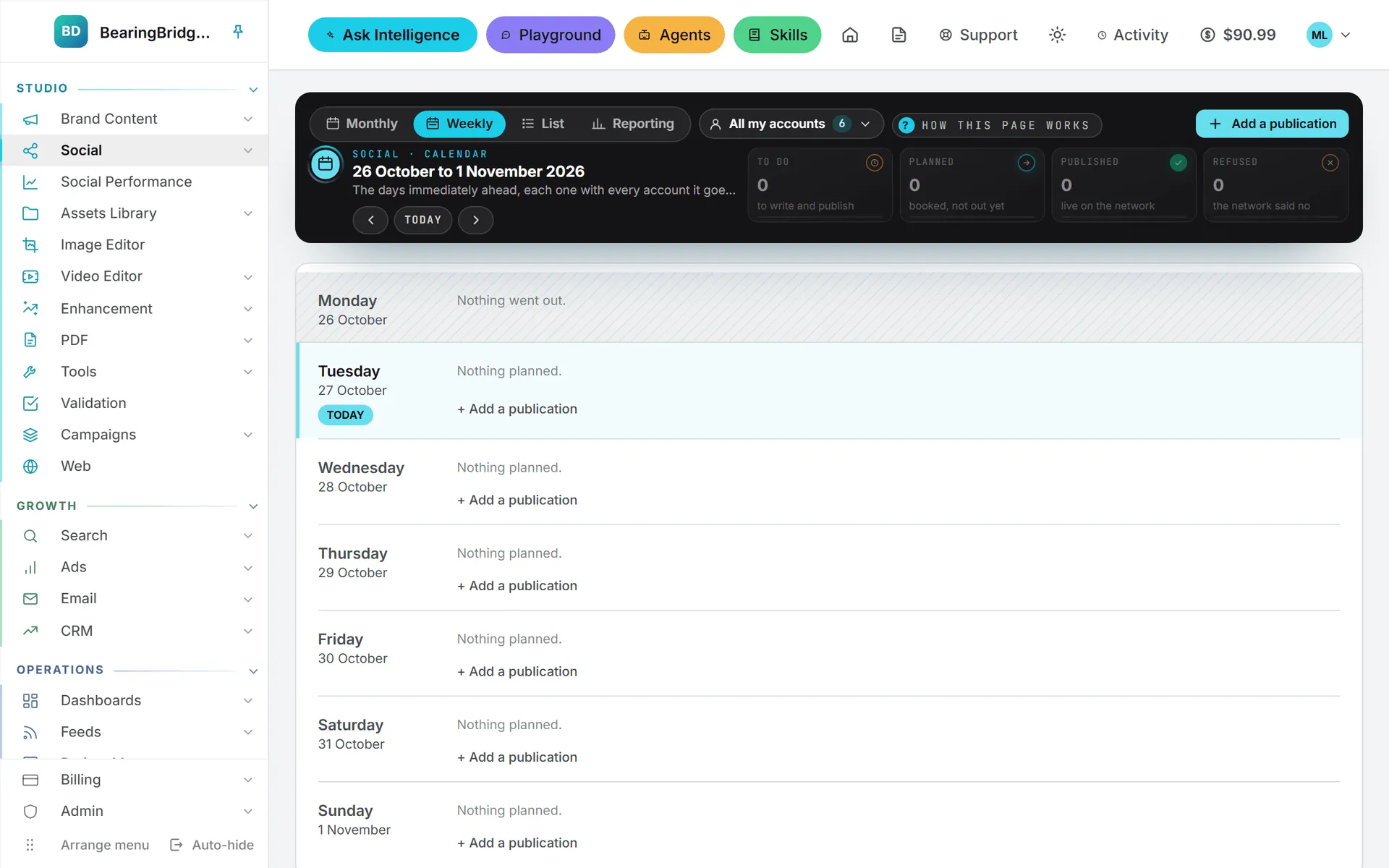
The weekly cards carry quick actions:
- Mark as published, for a post you published by hand
- Add the link, when it’s published but the link is missing
- View the post, once the link is there
- Edit the plan, on a post written in a studio, to change the plan around it without opening the post
- + Add a publication, under each day
The list view
List puts every publication on a line of its own, in the order it goes out: by day, then by hour. It’s the view for reading the plan from top to bottom, or for finding one post in it.
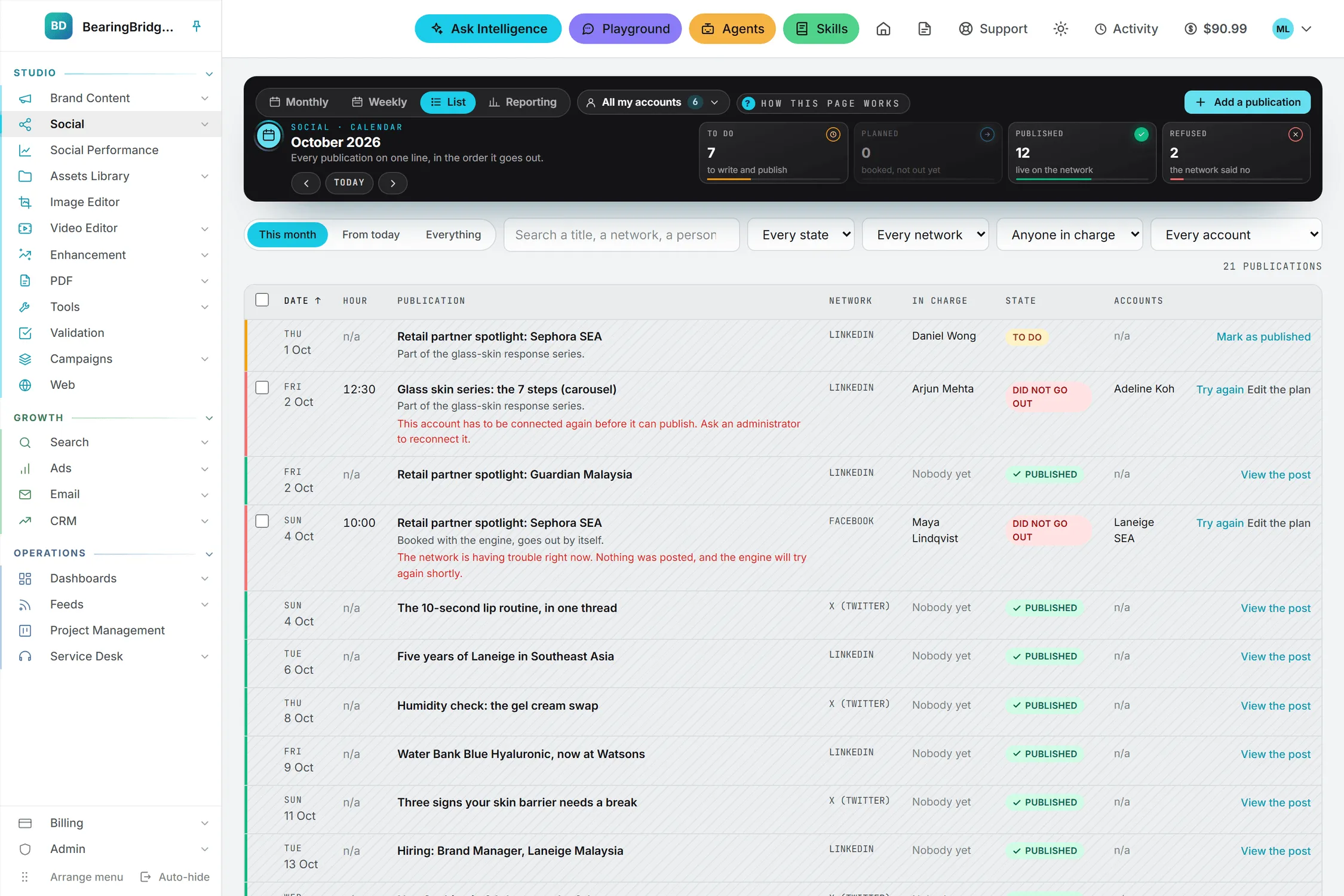
Pick the period above the table:
- This month, to walk month by month with the arrows on the band. The arrows and Today always bring the list back to this period.
- From today, for everything still ahead.
- Everything, for the whole plan.
Your browser remembers the period you picked. Next to it, the search box (“Search a title, a network, a person”) reads the title, the notes, the network, the brand, the accounts and the person in charge. The state list keeps one color: Every state, To do, Planned, Published or Refused. Three more lists narrow the table: Every network, Anyone in charge (or Nobody in charge) and Every account (or Not on an account yet). Each one only offers what the period and the search hold, so no choice leads to an empty list. Clear the filters puts the state and these three lists back to all. The total beside them says how many publications are shown, and the four tiles on the band count the period and the search, whatever the lists say.
Click any column header to sort the table on it; click again to reverse the order. An arrow marks the column in use, and your browser remembers it.
| Column | What it shows |
|---|---|
| Date | The weekday and the day, with a Today tag on today’s lines. |
| Hour | When it went live or is booked to go out, or n/a when nothing is booked. |
| Publication | The title, any notes and the network’s last error. |
| Network | The platform it’s planned on. |
| In charge | The person in charge, or Nobody yet. |
| State | Where it stands, as on the other views. |
| Accounts | The accounts the app sends it on, when it’s booked. |
The last column holds one action: View the post once the link is there, Edit the plan on a post written in a studio, Add the link on a published post with no link, or Mark as published. Click anywhere else on a line to open the publication. A post written in a studio opens in its studio.
Send failed posts again
A post with a send that did not go out gets a tick box at the start of its line, and the box in the header ticks them all. Once you tick one, a bar says how many are ticked and offers two ways out:
- Send again now: each send goes out at once, one after the other. A send that fails again shows the network’s reason.
- Put back in the queue at the time you pick (it opens on the next quarter hour but one): the sends go back to planned, five minutes apart, so a batch does not reach a network all at the same second.
Untick all clears the choice. The list is read again afterwards, so what you see is what was sent.
Add a publication
You can put a post on the plan before anyone has written a word of it.
- Click a day, or Add a publication on the band.
- Enter a Title: one line saying what the post is about.
- Check the Publish date.
- Pick the Platform: LinkedIn, WeChat, Instagram, Facebook, X (Twitter), YouTube, TikTok, Xiaohongshu (RED), Website or Other.
- Choose Who is in charge, or leave Nobody yet.
- Leave the status on To do, or pick Published if it’s already out.
- Add the Link to the published post once it’s live, and any Notes for the team.
- Click Save.
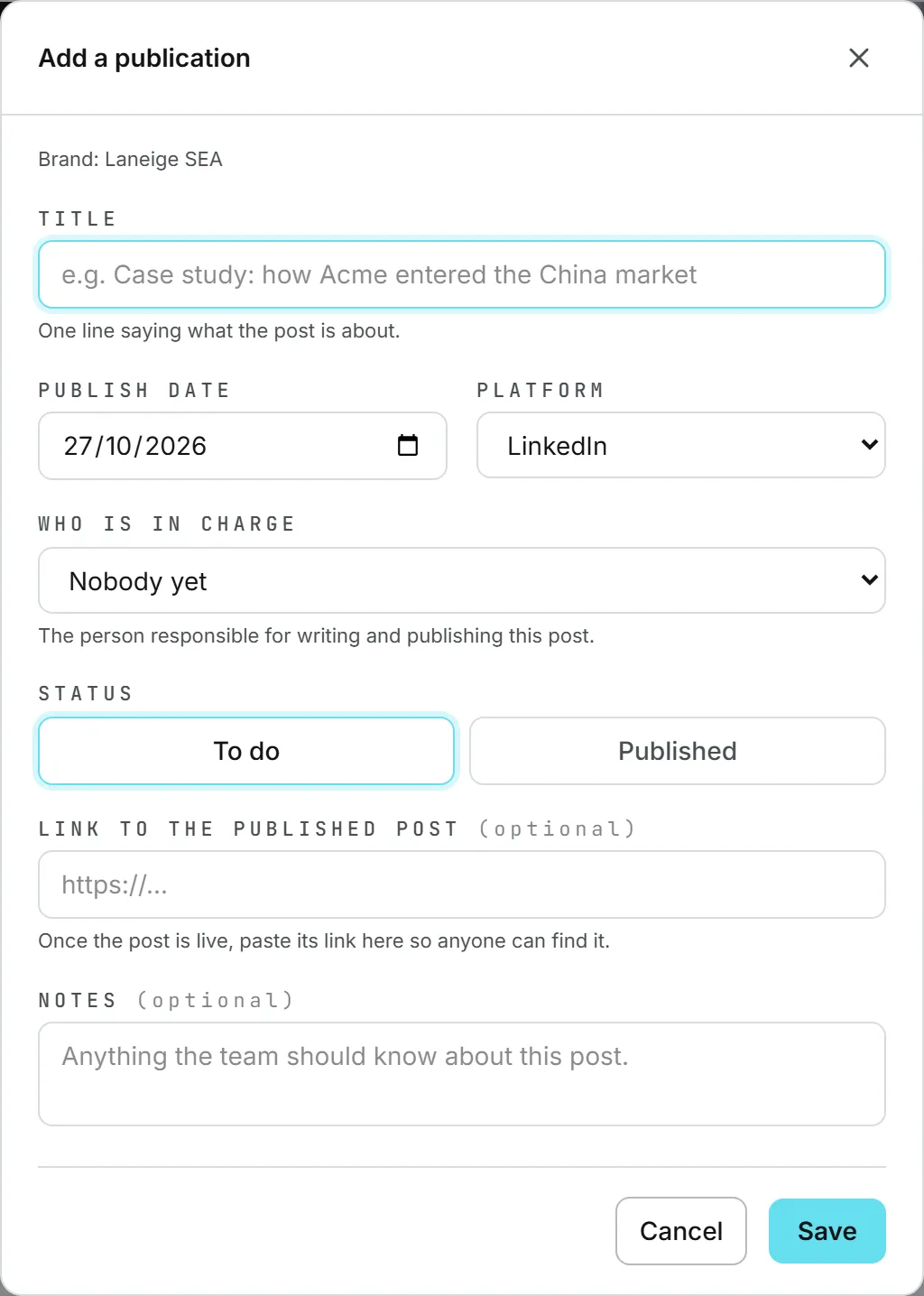
To change a publication, click it, edit and save. Delete sits in the same window when you’re allowed to delete it.
WeChat, YouTube, Xiaohongshu, Website and Other have no studio in Social. They’re there so the plan can hold every channel you use, and you keep them up to date yourself. Website is for the pages of your own site, so an article and the posts that share it sit on the same day of the plan.
Important: A publication planned here is a note on the plan. Setting it to Published records that it went out; it doesn’t publish anything. To have the app send a post, write it and schedule it in the network’s studio. See publishing.
Posts written in the studios
Everything above is the plan you type in yourself. Most posts, though, come from the studios, and there’s no need to copy them onto the calendar. A post scheduled in the LinkedIn, Instagram, Facebook, TikTok or X studio lands here on its own, with the account it goes out on. So does a post you mark as published in a studio.
Click one of these and you’re taken to the studio, on that post’s publishing step. If all you want to change is the plan, say who’s in charge, use Edit the plan on its weekly card or its line in the list.
Move a scheduled post
Drag a blue or red chip of the month grid, or its weekly card, to another day. The chips in a day’s window can’t be dragged: close it and drag from the grid. This moves the send itself, and the plan with it. The post keeps its hour, in your own time zone, and goes out on the new day. A refused send you drag goes back in the queue for a fresh try. The page reloads to show what the app will now do.
When a post goes out on several accounts, the chip stands for one of those sends, and the drag moves that one. Check the weekly card afterward to see where each account stands.
You can’t drop a post on a day that has already passed. The calendar tells you, and you can schedule it again from the post instead.
Choose the accounts and the network
A social account belongs to the person who connected it, not to a brand, so the calendar reads your own accounts across every brand you can see. Open the account button on the band:
- Networks at the top (LinkedIn, X (Twitter), Instagram and so on) narrow the calendar to the networks you click, as many as you like, and the list below to their accounts. Click a network again to drop it; All networks clears the choice.
- Each of your accounts has a box, with its network beside its name. Untick one to set its posts aside.
- Not on an account yet covers what is planned by hand or was published by hand, with nothing booked on an account.
- Tick all and Untick all, beside Accounts, tick or clear every account listed.
- Manage my accounts, at the bottom, opens My connections in a new tab, to connect another one. Close folds the list; what you ticked already applies.
The button says what is on: All my accounts, one account’s name or a count, after the networks when you picked some. Your choice is remembered in this browser, and an account you connect later is ticked from the start. A post that goes out only on a colleague’s account stays on their calendar, not yours.
The brand still matters for writing: a new publication is filed under the brand in the header and follows its guidelines (tone of voice and the rest of its attributes). A chip from another brand shows that brand’s name, and the window opens with a Brand: line when your organization has several. To find posts by person or by state, use the search and the state list of the list view.
Who can do what
What you can do on the calendar depends on your role, and on whose account a post goes out on.
| Action | Who |
|---|---|
| See the calendar | Anyone with the Social Calendar area open to them (see roles and rights) |
| Add, edit or mark a publication as published | Editors and above |
| Put someone in charge | Editors. The list only offers people you’re allowed to assign work to. |
| Delete a publication a brand or the organization can see | Admins |
| Delete a publication planned in the No brand workspace | The person who planned it, while only they can see it, or an admin |
| Move a scheduled send | Editors who may publish on the account the post goes out on |
The Reporting tab only shows when the Social Reporting area is open to you. See social reporting.
Costs, dates and privacy
The calendar itself costs nothing. Credits go on AI work in the studios, and on posts the app sends on X. To write the post itself, open its network’s studio, as described in writing posts.
Days and hours follow the time zone and formats you set in Settings. A publication planned in the No brand workspace is seen only by the person who planned it (see brands).
Troubleshooting
“That day has already passed.” You dropped a booked post on a past day. Pick a day ahead of now.
“Please give the publication a title.” The title is required. So is the publish date.
“Could not save:” followed by a reason. The server refused the change. The most common reasons are a brand deleted in the meantime, or a person you can’t assign work to.
“You cannot publish on that account.” You dragged a send that goes out on someone else’s account. Only people who may publish on that account can move it.
A post went red. The network refused it. Hover the chip or read the weekly card for the network’s own words, fix the post in its studio, then use Try again now there or drag it to a new day.
A studio post isn’t on the calendar. It appears once it’s scheduled or marked as published. A draft that’s only written isn’t on the plan yet. Add it by hand if you want it there.